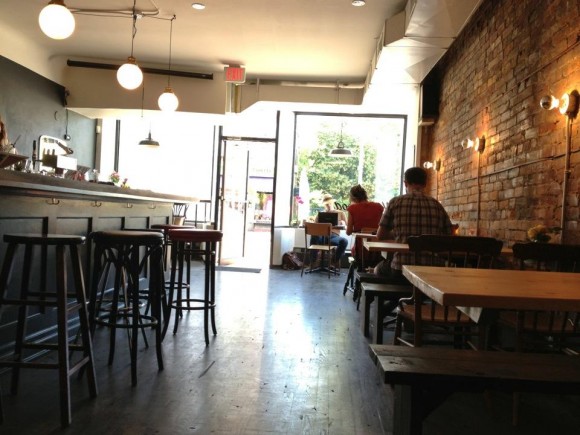
I had to do a bunch of research as I was writing today's excerpts, and it will become apparent precisely why when you see it. This scene takes place at Northwood, a bar near Jackie's place (with a lower case p). Nora has met up with Shalini for drinks, but upon arriving discovers that Noah and Oliver are with her. Oliver and Nora go up to the bar to get a drink, and this exchange happens:
“It sounded like brian j. Pickles was pretty excited about your latest book. Have you been doing a lot of publicity?”
“Some,” he said quickly. “I did an interview with the Toronto Star recently, and Maclean’s. Maybe the New York Times soon. I’ve done some CBC podcasts. I am not on social media. I do as little publicizing as I can manage. I hate it and it’s not the reason that I write my novels.”
“It can definitely be a pain,” Nora tersely agreed. “But interest in novels isn’t just going to exist on its own. You build it through social media, you build it by developing relationships with reviewers. It’s just part of the job.”
“I want my books to stand on their own.”
“Well, sure,” Nora could feel the annoyance rising in her chest. “I guess any person would rather not do work than do work. But it’s unfair to treat the work of finding an audience and connecting with them as debasing yourself.”
“It feels like begging people to read my novels,” Oliver shot back defensively.
“I get why you would feel that way. I really do. It would be great if our work could speak for itself and be reviewed exclusively based on merits. But I think it’s important for you to understand the extent to which women literally have had to beg people to read their novels. The fact that people respect you and your writing doesn’t happen in a vacuum. From my personal experience, I can tell you that as a woman and a writer it is often assumed that women writers will not write anything important - anything truly serious or necessary, revelatory or wise. I’m sure that you of all people can appreciate that being the author of a series of books called Pride and Prejuwitch, I am often met with skepticism and derision.”
Nora could see that she had hit Oliver hard with that comment. She thought she saw something resembling shame spread across his features as it dawned on him that she had heard everything that he had said about her on that day that they first met.
Nora, however, saw an opening for some education about sexist bias.
“It’s not just me. Don’t you remember when V. S. Naipaul, who won the Nobel Prize for literature, said in an interview that no woman had ever been his equal as an author, including Jane Austen? Or the critic, Norman Mailer, who said that he could, and I directly quote, ‘sniff out the ink of the women,’ which he absolutely did not mean as a compliment? Or that Christopher Hitchens wrote an entire article in Vanity Fair about why women aren’t funny? Don’t you think that attitudes like those impact people’s perceptions of women as authors and artists?”
“I completely agree with you. It’s sexist to say those things and I’m sorry that they did. But they’re in the minority with that opinion.” For the first time since Nora had met Oliver, he appeared to not be in total control of the social interaction. Nora took some pleasure in the fact that she was the reason that he was squirming.
“I would agree with you if it wasn’t a systemic problem. Women make up a disproportionately small number of book reviewers, and are considerably less likely than men are to have their books reviewed in the first place. When women and racial minorities are reviewed, it’s less likely to be by an outlet like the New York Times. It’s expected that their books will only reach a very narrow audience of people like them, rather than the supposed broad appeal of men’s writing. And novels featuring male protagonists are more likely to win literary awards.
Oliver was listening respectfully, but seemed slightly skeptical that there was systematic bias in an industry from which he had benefitted so greatly.
Nora continued, “It isn’t just women who are discriminated against in the literary world. With regards to authors who are racial minorities, change has been a lot slower than you would think. change is slow to come. A study tracking the number of books by African-American, Asian-American, Native/First Nations, and Latino book creators since 1994 showed that over the past 20 years, the number of multicultural books has hovered around 10 percent, with a sudden surge in 2015 to 20 percent. And think for a second about what it’s like for women who are racial minorities. It’s a constant uphill battle, that neither of us can really understand.”
Oliver had that somewhat guilty look on his face, the look that men like him often get when they are told that the ways that they are accustomed to moving about the world are so shaped by social forces that offer them a disproportionate amount of privilege. That there are experiences of the world that they have been shielded from by their blinders.
Nora, on the other hand, was just building towards a crescendo.
“And finally,” Nora gestured didactically, “being on social media is a lot harder for people in marginalized groups. As great as it was that your friend ‘Kiefer’ stood up to Doug Ford online, he probably wasn’t hit with the same threats of physical violence that I was for doing the same thing with much less inflammatory language. Think about that experience, of being scared out of participating in public conversations because there are so many terrible people who are determined to keep you out of them. But I also know that I have it easier than a lot of women do. I’m white, and my name sounds white, so getting a book agent was a lot easier. I really think that you need to open your eyes to the experiences of people who aren’t like you. Then maybe you would understand why self-promotion and publicity aren’t dirty words for people who have trouble being respected from their cover letter onwards.”
Nora took a sip of her “Little Red Corvette” cocktail, which had been forgotten while she was busy having another successful interaction with a man. She might have felt sorry for Oliver, if she hadn’t known so many men like him. Men who refused to see something that was so glaringly obvious to the rest of the world. Men whose ambition had been cultivated and rewarded, while that of others had been curtailed and dismissed at every turn. Men who shut the door behind them to protect the social status that comes from being in an exclusive club of esteemed thinkers.
“I’m sorry that happens to you,” he said, truly meaning “I’m sorry that I happened to you.”
“Me too,” Nora said.
From their table, Shalini and Noah noticed the pair standing at a distance, each knowing one participant in the dialogue very intimately. Shalini recognized the look on her friend’s face as one of indignant satisfaction. She had observed it many times before, after someone—usually a man—had gravely underestimated her while overreaching their own knowledge, as they often did. Noah, on the other hand, didn’t recognize the look on his friend’s face at all. Unnerved, discomposed, flustered. A look that said, “I don’t know what just happened, but I want it to happen again.”
He had never seen this look on his friend’s face, but he hoped that it wouldn't be the last.
What a great excerpt! I was pumping my fist, cheering for Nora as she delivered blow upon blow to Oliver. Kudos to him for apparently being willing to listen and learn, and for enjoying being challenged by a woman.
ReplyDeleteMy favourite line of the excerpt had to be:
Nora took a sip of her “Little Red Corvette” cocktail, which had been forgotten while she was busy having another successful interaction with a man.
Your novels are so full of these funny little details, so that even when a serious conversation is taking place, there are these comedic little bits that take the reader by surprise!
Whoa, Nora just delivered an epic lesson to a white man and I enjoyed every word of it. Completely perfect in tone and content. Sad that this was clearly fiction in that Oliver seemed to take what she said as a moment for serious self-reflection. I truly almost cried at the last part, that Oliver had a look on his face that his friend had not seen before and that Oliver wanted it to happen again. I wish and hope that such successful interactions with a man are possible!
ReplyDeleteNoah, on the other hand, didn’t recognize the look on his friend’s face at all. Unnerved, discomposed, flustered. A look that said, “I don’t know what just happened, but I want it to happen again.”
ReplyDeleteWow! What a beautiful ending to what was an otherwise very informative section. The way Nora took Oliver down was epic and I'm so proud of her and you for writing it. I'm really looking forward to seeing how this changes Oliver as a character.
Aah Katie I’m so sorry I fell off the map for the last couple posts! This week has so far been a little hectic with not much downtime or access to Internet. But I’m back, baby! And so excited to read what you’ve written! This excerpt is such an epic factual beatdown; I definitely learned some new interesting statistics about the publishing industry, and I think Oliver certainly learned his lesson about complaining about his white male privilege. “Well, sure [...] I guess any person would rather not do work than do work” - BURN. I think it’s going to take Oliver a while to recover from that one. I love that Nora takes this opportunity as a teaching moment, and it’s really satisfying watching Oliver flail in the face of Nora’s cold hard facts. I could really *feel* this conversation, the tension, the frustration - having had many variations on this kind of talk with various men over the years, as I know you have. I am so envious of Nora’s ability here to completely dominate that conversation. It wouldn’t be a Katie Esmonde novel without discussions of systemic sexism and racism but I’m really enjoying the strong through-line in both the story and the story-within-a-story of characters calling out and challenging the entrenched patriarchal structures. You’ve really woven that into the structure of both stories and made it integral to the plot rather than just talking points. By the way, do you have a title yet for this novel? If not, I’d like to throw “Patriarchy and Prejuwitch” out there into the running :) This last moment as Noah and Shalini observe their respective pals up at the bar and see wildly different things is perfect; they know their friends well. Hahaha I definitely take the look on Oliver’s face to mean that he has the most confused boner right now - just like many Mr. Darcys before him.
ReplyDelete